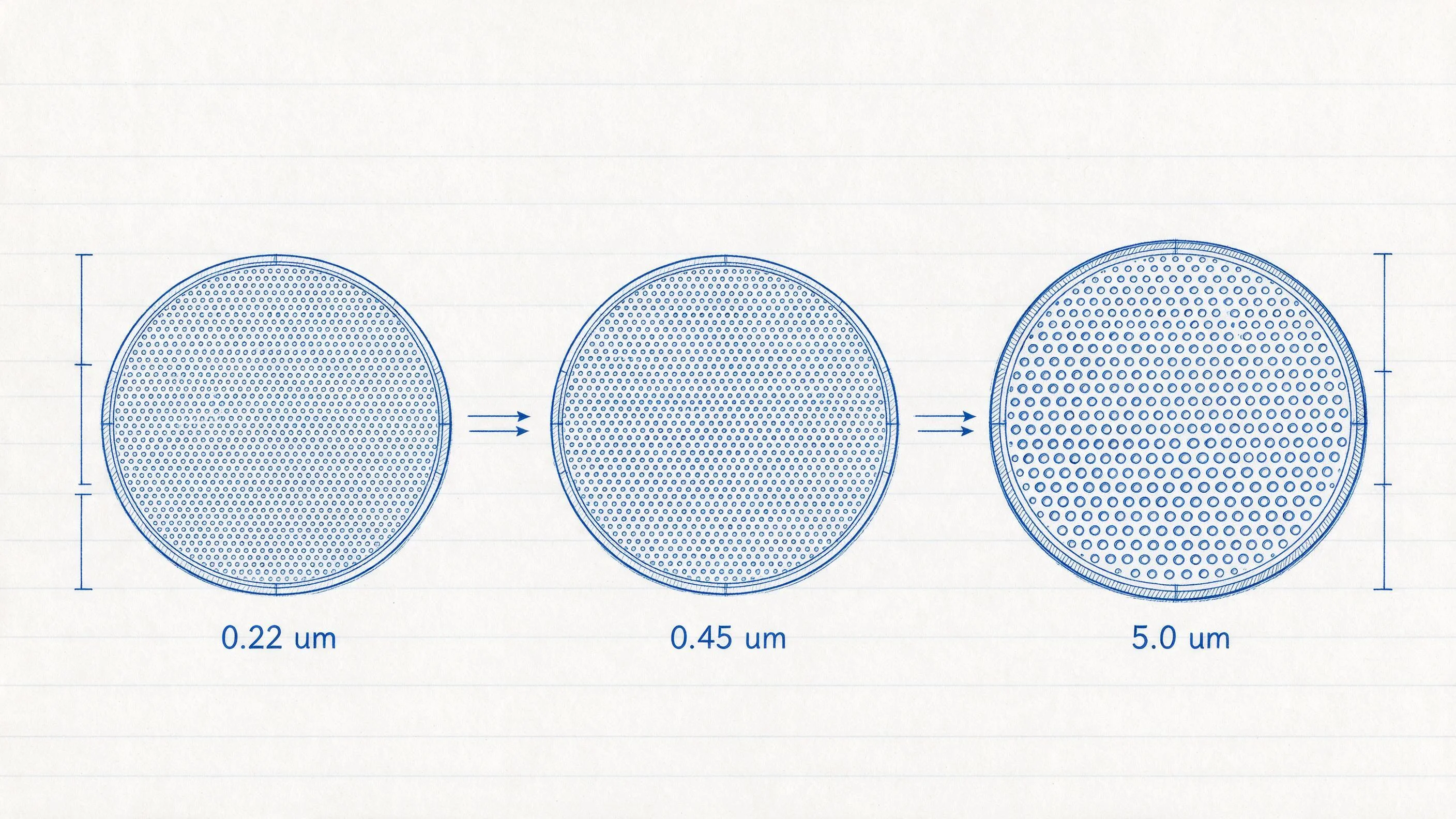
Pore Size Ratings: What the Number Actually Specifies
A pore size rating on a syringe filter is a retention specification, not a measurement of a single geometric hole. Most membranes used in syringe filtration are microporous and tortuous: liquid travels through an interconnected network of channels that narrow and widen along the path. The rated value is a nominal figure derived from retention testing against defined challenge particles or organisms under defined conditions. Two devices carrying the same 0.22 µm label from different manufacturers can differ measurably in flow rate, analyte binding, and retention margin.
The practical consequence for method development: treat the number as a starting point, not a guarantee. Device integrity is controlled during manufacturing, and for critical work it can be verified on the bench by bubble-point or forward-flow testing.
Five Variables, Not One
Pore size is only one of the parameters that determine what a filter does to a sample:
- Pore size rating — what is retained
- Membrane chemistry — what is adsorbed, and what solvent the device tolerates
- Effective filtration area — how fast the device flows and how much it holds up
- Housing and assembly — weld quality, dead volume, pressure limits
- Sample properties — particle load, viscosity, solvent, pH
Changing the pore size addresses only the first. A clogged 0.22 µm filter is often a prefiltration problem, not a pore-size problem.
0.22 µm vs 0.45 µm: Sterilization and Clarification
A common specification error in sample preparation is treating 0.45 µm and 0.22 µm as interchangeable. They serve different purposes.
0.45 µm — clarification grade. Removes general particulate: dust, precipitated protein, undissolved sample, fibres, and debris that would foul a column frit or injector. It does not reliably retain bacteria and is not a sterilizing filter.
0.22 µm — suitable for sterilizing filtration when the device and conditions are validated. Written as 0.2 µm in many methods; the two notations refer to the same nominal rating class. The sterilizing-grade claim for aqueous solutions rests on retention of *Brevundimonas diminuta* at a defined challenge level under validated conditions, combined with integrity testing of the device — not on the pore size number alone.
| Attribute | 0.45 µm | 0.22 µm |
|---|---|---|
| Primary purpose | Clarification | Sterilization |
| Bacterial retention | Not a sterilizing claim | Sterilizing-grade option when the device and conditions are validated |
| Flow rate | Higher | Lower |
| Clogging behaviour | Tolerates higher particle load | Blinds earlier on turbid samples |
| Typical use | Dissolution samples, mobile phase, general cleanup | Sterile media, buffers, biological solutions, final filtration before LC |
| Combination | Use as a prefilter ahead of 0.22 µm on loaded samples | Use downstream of 0.45 µm when particulate load is high |
0.1 µm and 0.2 µm Syringe Filters: Fine Particulate Control
Where a 0.22 µm device is not sufficient, a tighter rating is specified. Typical drivers:
- Mycoplasma reduction, where a 0.1 µm rating is conventionally used
- Virus-related clearance claims
- Sub-2 µm UHPLC columns, where particle shedding below the 0.22 µm cut-off can still damage the bed
- Nanoparticle and liposome suspensions, where aggregate removal above a defined threshold matters
The trade-offs are predictable. A 0.1 µm syringe filter has lower flux, higher backpressure, and a greater sensitivity to clogging than a comparable 0.22 µm device. Hand pressure from a syringe may be insufficient; larger diameters, prefiltration, or positive-pressure delivery are often required.
Catalogued pore sizes in the ALWSCI Labfil syringe filter range run from 0.22 µm to 5.0 µm. Where a method mandates a 0.1 µm rating, confirm current availability and membrane options with an applications engineer before writing the specification into a validated procedure.
5.0 µm Syringe Filters: Prefiltration, Not Clarification
A 5 micron syringe filter is a prefiltration device. It does not sterilize, and it does not deliver clarified filtrate at the level a chromatographic method usually requires. Its function is to remove the bulk of large particulate so the downstream membrane is not blinded before the sample has passed through.
Typical applications:
- Soil, sediment, and sludge extracts
- Wastewater influent and other high-solids aqueous samples
- Food, feed, and beverage slurries
- Dissolution of powdered formulations before assay
- Viscous, coloured, or visibly fibrous samples
The standard configuration is a two-stage stack: 5.0 µm first, then 0.22 µm or 0.45 µm. Glass fibre (GF) is the usual prefiltration medium because it holds a high particulate load and is available as a depth-type disc. Two cautions apply. First, prefiltration adds surfaces and a transfer step. Second, hydrophobic analytes can adsorb to the prefilter, so recovery should be verified on a representative matrix before the method is locked.
Diameter and Throughput: 4, 13, 25 and 33 mm
Pore size determines what is retained. Diameter determines how fast the device flows, how much sample it can process before clogging, and how much liquid remains trapped in the housing after filtration.
| Diameter | Relative filtration area | Typical sample volume (general guidance) | Typical use |
|---|---|---|---|
| 4 mm | Smallest | Below 1 mL | Micro-volume work, costly or scarce samples, low hold-up requirement |
| 13 mm | Small | 1–10 mL | Routine sample preparation for LC and GC |
| 25 mm | Medium | 10–100 mL | Larger volumes, moderate particulate load, sterile filtration of buffers |
| 33 mm | Largest | Above 100 mL, or heavily loaded samples | Bulk solvent filtration, viscous samples, prefiltration stages |
Sample volume ranges and area comparisons above are general industry guidance, not product specifications. Confirm dimensions and hold-up volume against the current datasheet for the specific part number.
Hold-up volume deserves separate attention. A membrane retains liquid that never reaches the collection vessel. For small samples — where analyte mass is limited — a smaller diameter, an air purge at the end of filtration, or discarding the first fraction of filtrate can materially change recovery. For large volumes of low-value solvent, the largest practical diameter will reduce time and syringe changes.
Selection Table by Application
The following is general method guidance. Membrane recommendations reflect common analytical practice and should be confirmed against the specific method and matrix.
| Application | Pore size | Membrane (typical) | Sterile? |
|---|---|---|---|
| Aqueous LC mobile phase | 0.22 µm (0.45 µm acceptable on ≥3 µm columns with high particulate) | Nylon, PVDF, PES, RC | Non-sterile |
| UHPLC, sub-2 µm packing | 0.2 µm; 0.1 µm where the method specifies | PES, PVDF, Nylon | Non-sterile |
| Organic solvent samples | 0.22 or 0.45 µm | PTFE (hydrophobic), Nylon | Non-sterile |
| Protein and biological aqueous samples | 0.22 µm | PES, PVDF, RC (low binding) | Usually sterile |
| Cell culture media, buffers, additives | 0.22 µm | PES, CA | Sterile |
| Dissolution testing | 0.45 µm | PVDF, PTFE, Nylon, RC | Non-sterile |
| Soil, wastewater, food extracts | 5.0 µm then 0.22/0.45 µm | GF, then membrane | Non-sterile |
| Viscous or gel-like samples | 5.0 µm prefiltration | GF | Non-sterile |
| Environmental water, TOC | 0.45 µm typically | PVDF, PES, GF | Non-sterile |
Membrane chemistry notes: Nylon suits aqueous and organic solvents; PTFE is chosen for aggressive solvents and requires pre-wetting for aqueous samples; PVDF and PES give high flux with low protein binding; CA is used in biological and aqueous service; RC offers low binding for aqueous work; MCE suits general aqueous particulate removal; GF is a depth medium for prefiltration, not a sterilizing membrane.
Sterile and Non-Sterile Lines
ALWSCI supplies syringe filters across three process lines — Welded, Economy, and Sterile — in both sterile and non-sterile configurations. Available membrane materials are Nylon, PTFE, PVDF, PES, MCE, CA, RC, and GF, with pore sizes from 0.22 µm to 5.0 µm and diameters of 4, 13, 25, and 33 mm.
For purchasing decisions:
- Sterile devices carry a sterility claim and individual packaging. Specify sterile devices where required, and validate filtration and handling for the intended sterility requirement or the method mandates a sterile device.
- Non-sterile devices are appropriate for routine sample preparation, mobile phase filtration, and prefiltration.
- Never substitute a non-sterile device into a method that specifies a sterile one.
- Documentation available includes per-batch COA, SGS reports, and MSDS. The company holds ISO 9001:2015, ISO 14001:2015, ISO 45001:2018, ISO 13485:2016 and ISO/IEC 17025:2017 management-system certifications. Certificates available upon request.
Practical Selection Checklist
- Define the purpose — sterilization, clarification, or prefiltration. This decides 0.22, 0.45, or 5.0 µm before any other choice is made.
- Read the method. If it specifies a 0.2 µm or 0.1 µm rating, do not default to 0.45 µm for convenience.
- Check chemical compatibility between membrane and sample solvent.
- Assess particle load. Visibly turbid or high-solids samples get a 5.0 µm prefiltration step.
- Match diameter to volume and syringe. Hold-up volume is a recovery risk on small samples.
- Confirm sterility requirement and document it on the purchase order.
- Consider binding. Protein, peptide, and low-concentration analyte work favours PES, PVDF, or RC.
- Run a recovery check on a representative matrix before adopting the device into a validated method.
- Confirm documentation — batch COA, MSDS, and any certificate required by your quality system.
- Qualify on samples, not on paper.
Next Step
Send the specification you are working to — pore size, membrane, diameter, sterility, and pack format — and the selection can be matched against catalogue and custom options. Request Free Samples for bench qualification, Talk to an Applications Engineer for method-specific guidance, or Send Your Spec Sheet for OEM and private-label configurations.
Zhejiang ALWSCI Technologies Co., Ltd. Email: marketing@alwsci.com | Tel: +86 571 8883 7380 | Fax: +86 571 8801 2781